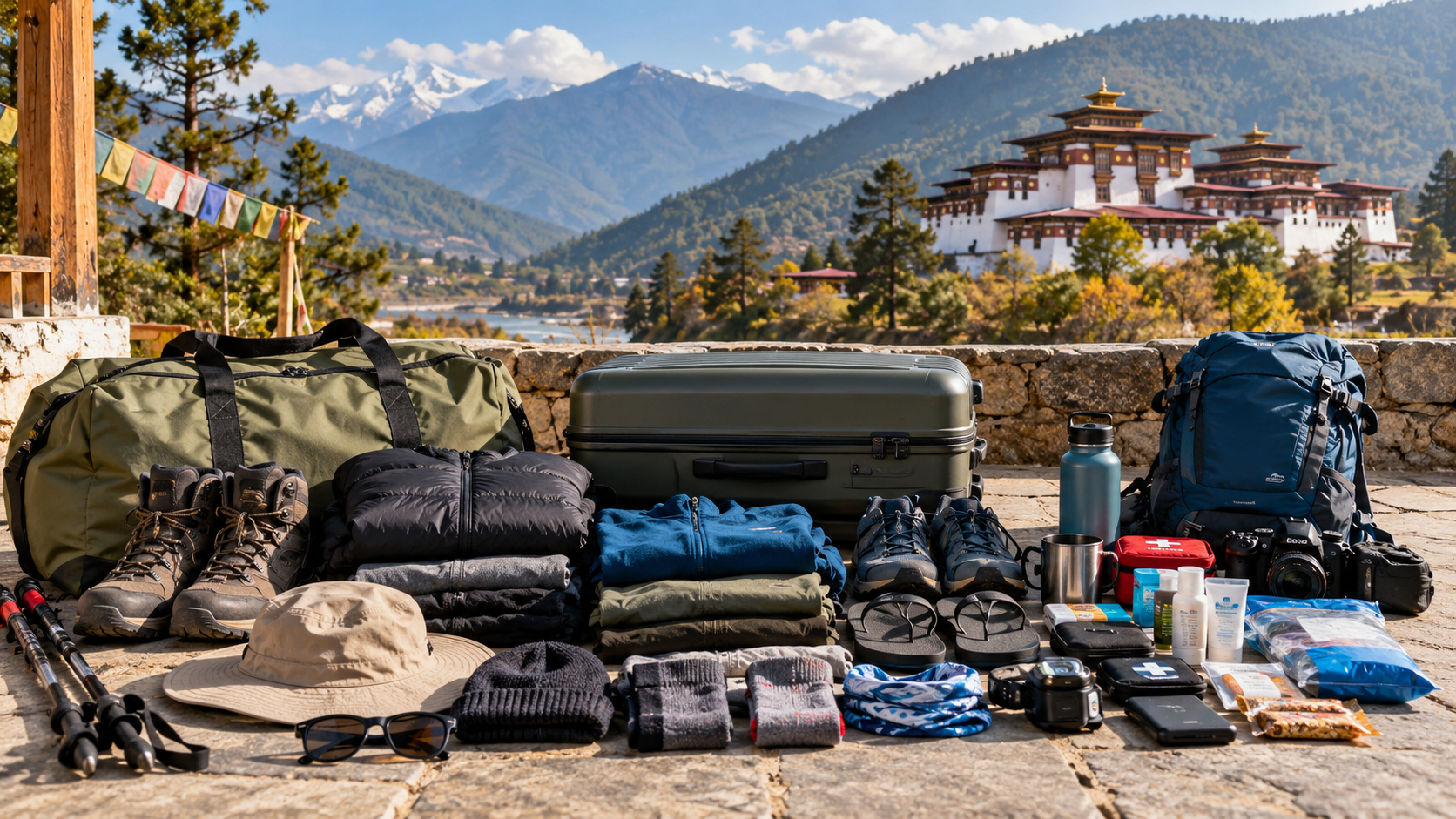
Bhutan has a remarkable range of temperatures and climatic conditions, sometimes within the same journey. While Thimphu may be chilly, Punakha can be pleasantly warm or even hot. At higher elevations, temperatures can change quickly, especially in the mornings and evenings.
For this reason, we strongly recommend dressing in layers. Several light layers are generally more comfortable and effective than one or two very heavy garments, as you can add or remove clothing as the temperature changes throughout the day.
Where possible, choose comfortable, breathable clothing and bring clothes that you have already worn and know you are comfortable in. Good walking shoes, sufficient socks and underwear, and a warm layer for the evenings are particularly useful.
During the colder months, thermal innerwear is highly recommended. Lightweight thermal tops and bottoms are warm, take up very little space and dry quickly after washing.
Dressing for Monasteries & Dzongs
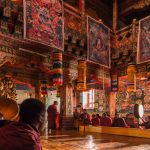
When visiting monasteries, dzongs, temples and other religious institutions, please dress modestly and respectfully.
Shoulders and knees should generally be covered. Hats and caps should be removed before entering temples and sacred spaces, and smoking is not permitted within religious premises.
Your guide will always advise you where particular etiquette or dress requirements apply.
General Packing List
The following is a fairly comprehensive list. You certainly do not need to bring everything mentioned here. Choose according to the season, the length of your journey and your personal travel style.
Clothing & Travel Essentials
– Comfortable clothing suitable for layering
– Warm fleece, sweater or light jacket
– Down jacket during the colder months
– Comfortable, well-worn walking shoes
– Lightweight casual shoes
– Comfortable socks and underwear
– Sun hat or cap
– Warm hat during colder months
– Light gloves if travelling in winter
– Rain jacket, poncho or umbrella, particularly from June to September
– Sunglasses
– Spare spectacles if required
– Small daypack
– Travel pouch for passports, money, air tickets and important documents
Personal Items
Depending on your preferences, you may also find the following useful:
– Sunscreen
– Lip balm
– Moisturiser or hand cream
– Insect repellent
– Personal toiletries
– Small sewing kit and safety pins
– Hand sanitiser
– Basic first-aid items
– Antihistamine
– Medication for stomach discomfort or diarrhoea
– Pain relief medication
– Any prescription medication you regularly use
Please carry enough of your prescription medication for your entire journey, preferably in your hand luggage.
If you wear contact lenses, we recommend bringing spectacles as a backup. At higher altitudes, dry air and wind can sometimes make contact lenses uncomfortable.
Electronics
Bhutan is exceptionally photogenic and most travellers find themselves taking considerably more photographs than expected.
Bring:
– Camera or phone
– Chargers
– Power bank
– Spare batteries where applicable
– Extra memory cards if using a camera
A Small Tip About Dogs
Bhutan has many free-roaming dogs, particularly in towns. They tend to sleep during the daytime and can sometimes become active and vocal at night.
Light sleepers may therefore appreciate having a pair of earplugs.
Additional Packing Guide for Trekkers
Trekking in Bhutan is very different from travelling between towns and valleys. Weather in the Himalayas can change unexpectedly, regardless of season.
Conditions elsewhere in the region, including disturbances around the Bay of Bengal, can occasionally bring unexpected rain or snowfall to Bhutan. You should therefore be prepared for sun, cold, rain and occasionally snow, particularly at higher elevations.
At the same time, there is no need to overpack.
We often say that we pack our fears when we travel. Everyone has different comforts and different ideas about what they may need. But on journeys such as these, travelling lighter usually makes the experience considerably more enjoyable.
Fewer things to organise each morning means less time packing and more time enjoying your surroundings — perhaps even another cup of coffee in the morning sun.
Use the following as a guide rather than a compulsory checklist. Consider the season, altitude and number of trekking days and bring only what is useful to you.
Important Note About Your Trekking Luggage
You do not need to bring a large trekking rucksack.
A small daypack is sufficient for the things you want to carry with you during the day’s walk — such as water, your camera, sunscreen, rain jacket and a few personal essentials.
Your remaining clothing and belongings can be packed in a small suitcase or duffel bag.
Ponies will carry your suitcase or duffel bag between camps, so you will not need to carry your main luggage while trekking.
If there are clothes, shoes or other belongings that you do not need during the trek, you can simply leave them behind with us. Our team will keep them safely for you and have them ready when you return from the trek.
There is no need to take your entire holiday luggage into the mountains.
We will also provide sleeping bags and sleeping bag liners/inners for the trek.
If you are more comfortable using your own sleeping bag or sleeping bag liner, you are of course welcome to bring it.
Recommended Trekking Clothing
– Down jacket or parka
– Warm fleece jacket
– Comfortable, broken-in trekking boots
– Lightweight shoes
– Camp shoes, sandals or flip-flops
– Waterproof rain jacket and rain trousers
– Approximately four pairs of trekking socks
– Two long-sleeved thermal/base-layer shirts
– Thermal bottoms — medium and/or heavyweight depending on season
– Two trekking shirts; quick-drying/non-cotton fabric is preferable
– Trekking trousers
– Zip-off trekking trousers if preferred
– One pair of shorts
– Warm gloves
– Warm hat
– Sun hat
– Bandana or buff
– Sunglasses
Good trekking boots are particularly important. Whatever brand you choose, please make sure you have worn them before arriving in Bhutan. A trek is not the place to break in a new pair of boots.
Trekking Equipment & Personal Gear
– Small daypack
– Small suitcase or duffel bag for your main trekking luggage
– Trekking poles
– Gaiters/mud guards if desired
– Headlamp with spare batteries
– Small torch if preferred
– Camera and spare batteries/power bank
– Earplugs
– Reusable water bottle
– Insulated drinking mug if you prefer your own
– Small quick-drying towel
– Waterproof bags or zip-lock bags for separating clothing and keeping equipment dry
If you use a hydration bladder or CamelBak, carrying an additional normal water bottle can also be useful, particularly in colder conditions.
Personal & Medical Items for the Trek
You may wish to carry:
– Hand sanitiser
– Small personal medical kit
– Travel-size shampoo and soap
– Sunscreen
– Lip protection
– Insect repellent
– Prescription medication
– Personal snacks or energy bars
– A book or Kindle for evenings at camp
Our trekking team will take care of drinking water arrangements. Your guide will brief you on water safety and purification during the trek.
Trekking Equipment Provided by Breathe Bhutan
Our trekking team will provide the major camping equipment required for your journey, including:
1. Sleeping tents
2. Dining tent
3. Kitchen tent
4. Toilet tent
5. Inflatable sleeping mats or mattresses
6. Carpets for the tents
7. Hot-water bags
8. Tables and chairs
9. Sleeping bags
10. Sleeping bag liners/inners
11. Additional blankets when required
12. Pillows
13. Duffel bags when required
14. Gamow bag / Portable Altitude Chamber for applicable high-altitude treks
Our team will also transport and set up the camping equipment each day.
Pack Light, Pack Smart
There is no perfect packing list because every traveller is different.
Some people travel comfortably with very little, while others enjoy having a few familiar comforts with them. Both are perfectly fine.
Our suggestion is simply to pack for the conditions rather than for every possibility.
For the trek, take only what you genuinely need. Anything extra can be left behind with our team, and we will take care of it until you return.
Bring reliable footwear, good layers, rain protection and the personal essentials that matter to you. We will take care of most of the rest.
The lighter and more organised you travel, the easier the mornings become — leaving you more time to enjoy Bhutan rather than pack it.I especially like the line “There is no need to take your entire holiday luggage into the mountains.” It makes the arrangement immediately clear without sounding overly procedural.
Bhutan Packing Guide: Detailed Q&A
General Packing Questions
1. What kind of weather should I expect in Bhutan?
Bhutan has a wide range of temperatures and climatic conditions, often within the same journey. One valley may feel warm while another is considerably cooler. For example, Punakha can be pleasantly warm or even hot while Thimphu may feel chilly, especially in the mornings and evenings.
Temperatures also change quickly with altitude, so it is best to prepare for several conditions rather than pack for one fixed climate.
2. What is the best way to dress in Bhutan?
We strongly recommend dressing in layers.
Several lighter layers are generally more practical than one or two very thick garments because you can add or remove layers throughout the day as temperatures change.
A typical combination might include:
– A breathable base layer
– A shirt or light top
– A fleece or sweater
– A light or warm jacket depending on the season
Layering is especially useful when travelling between valleys at different elevations.
3. Should I bring very heavy winter clothing?
Not necessarily.
Unless you are travelling during the colder months or going on a high-altitude trek, you may not need very heavy clothing. Layers are often more practical.
For colder conditions, a good down jacket, warm fleece and thermal innerwear should cover most situations.
4. Should I bring thermal underwear?
Yes, especially if you are travelling during the colder months or trekking at higher elevations.
Lightweight thermal tops and bottoms are particularly useful because they provide warmth without taking up much luggage space. They also dry quickly after washing.
5. What kind of shoes should I bring?
For a general cultural journey, comfortable and well-worn walking shoes are ideal.
Avoid bringing completely new shoes that you have never worn before.
If your itinerary includes trekking, bring proper trekking boots that have already been broken in.
6. Do I need formal clothing?
Generally, no.
Bhutan is relaxed when it comes to visitor clothing. Comfortable, practical clothes are suitable for most situations.
The main consideration is dressing respectfully when visiting monasteries, dzongs, temples and other religious places.
7. Should I pack an umbrella?
An umbrella can be useful, particularly during the wetter months from around June to September.
A waterproof jacket or poncho may be more practical if you expect to walk frequently, but some travellers prefer carrying a small umbrella as well.
8. Should I bring rain gear even outside the monsoon season?
Yes, particularly if you are trekking.
Weather in the Himalayas can be unpredictable at any time of year. Rain or even unexpected snowfall can occur at higher elevations.
For regular cultural journeys, lightweight rain protection is usually sufficient outside the wetter months.
Clothing & Etiquette
9. What should I wear when visiting monasteries and dzongs?
Please dress modestly and respectfully.
As a general rule:
– Cover your shoulders
– Cover your knees
– Avoid very revealing clothing
– Remove hats and caps before entering temples or sacred spaces
Your guide will advise you whenever a particular place has additional requirements.
10. Can I wear shorts in Bhutan?
Yes, in casual settings.
However, shorts may not be appropriate when entering monasteries, dzongs and other religious institutions unless they adequately cover the knees.
If you are sightseeing during warm weather, carrying a light pair of trousers or suitable covering can be useful.
11. Can I wear a hat inside a monastery?
No.
Hats and caps should normally be removed before entering temples and other sacred indoor spaces.
12. Is smoking allowed at monasteries or dzongs?
Smoking should be avoided within religious premises.
Your guide will advise you on appropriate places and local rules.
Luggage
13. What kind of luggage should I bring to Bhutan?
For a regular cultural journey, bring whatever luggage is comfortable for you.
A medium suitcase or duffel bag works well for most travellers.
A small daypack is also useful for daily sightseeing.
14. Do I need a large backpack for Bhutan?
No.
For most journeys, you do not need a large backpack.
A small daypack is enough for carrying daily essentials such as:
– Water
– Camera
– Sunscreen
– Rain jacket
– Sunglasses
– Personal medication
– Small valuables
15. What should I keep in my daypack?
We recommend carrying only what you may need during the day.
Typical items include:
– Water bottle
– Camera or phone
– Power bank
– Sunscreen
– Sunglasses
– Hat
– Rain jacket
– Personal medication
– Passport or valuables when necessary
– Small snacks
Personal Items
16. What personal care items should I bring?
You may wish to bring:
– Sunscreen
– Lip balm
– Moisturiser
– Hand cream
– Personal toiletries
– Hand sanitiser
– Insect repellent
– Small first-aid items
These are mostly personal preference rather than strict necessities.
17. Should I bring insect repellent?
It can be useful, particularly in warmer valleys and during warmer months.
It may be less important in colder or higher-altitude areas.
18. Should I bring sunscreen?
Yes.
The sun can feel surprisingly strong at altitude, even when the air feels cool.
Sunscreen is useful throughout the year, especially for trekking and outdoor sightseeing.
19. Should I bring lip balm?
Yes.
The air can be dry, especially at higher elevations and during colder months, so lip balm is very useful.
20. What medication should I bring?
Bring any prescription medication that you use regularly, and bring enough for your entire journey.
You may also wish to carry a small personal medical kit with items such as:
– Pain relief medication
– Antihistamine
– Medication for stomach discomfort
– Anti-diarrhoea medication
– Any medicine you know you personally rely on when travelling
We recommend keeping essential prescription medication in your hand luggage.
21. Should I bring my prescription medication in my checked luggage?
It is better to keep essential medication in your hand luggage.
This ensures that you have access to it even if your checked luggage is delayed.
Contact Lenses & Eyewear
22. Can I wear contact lenses in Bhutan?
Yes, but some travellers may find contact lenses uncomfortable at higher elevations because of dry air, wind and dust.
If you normally wear contact lenses, we recommend bringing a pair of spectacles as a backup.
23. Should I bring sunglasses?
Yes.
Sunglasses are useful throughout Bhutan and especially important while trekking or travelling at higher elevations.
Electronics & Photography
24. Should I bring a camera or is a phone enough?
Either is fine.
Bhutan is exceptionally photogenic, and many travellers find themselves taking more photographs than expected.
If photography is important to you, bring whichever camera system you are most comfortable using.
25. Should I bring spare batteries or a power bank?
Yes.
A power bank is particularly useful on long days and during trekking.
If your camera uses removable batteries, bringing at least one spare is recommended.
26. Should I bring extra memory cards?
If you are using a camera, yes.
You may take considerably more photographs than you expect, so having additional storage is useful.
Dogs & Sleeping
27. Why do you recommend bringing earplugs?
Bhutan has many free-roaming dogs, particularly in towns.
They often sleep during the daytime and can become more active at night. In some locations, barking may disturb light sleepers.
A small pair of earplugs can therefore be surprisingly useful.
Trekking in Bhutan
28. Do I need a trekking rucksack?
No.
You do not need a large trekking rucksack for most Breathe Bhutan treks.
A small daypack is sufficient for the items you personally want to carry during the day’s walk.
29. What should I carry while walking on the trek?
Usually just your daily essentials, such as:
– Water
– Camera or phone
– Sunscreen
– Sunglasses
– Rain jacket
– Personal medication
– Small snacks
– An extra warm layer if necessary
There is no need to carry all your clothing and equipment yourself.
30. Who carries my main luggage during the trek?
Ponies will carry your main luggage between camps.
Your clothing and other belongings can be packed in a small suitcase or duffel bag.
You only need to walk with your daypack.
31. Can I really take a small suitcase on a trek?
Yes.
You do not necessarily need a traditional trekking backpack for your main luggage.
A small suitcase or duffel bag can be transported by pony between camps.
A duffel bag may be more convenient in some conditions, but a suitable small suitcase can also work.
32. Do I have to take all my holiday luggage on the trek?
No.
There is no need to take your entire holiday luggage into the mountains.
If there are clothes, shoes or other belongings that you do not need during the trek, simply leave them behind with our team.
We will keep them safely for you and have them ready when you return.
33. What happens to the belongings I leave behind?
Our team will take care of them while you are trekking.
They will be safely stored and returned to you once you complete the trek.
34. How much should I pack for the trek?
Pack only what you genuinely expect to use.
Consider:
– Number of trekking days
– Altitude
– Expected temperatures
– Rain
– Personal comfort
– How often you expect to change clothing
Travelling lighter makes packing and unpacking at camp much easier.
35. Why do you recommend packing light for trekking?
Because there is very little advantage in taking unnecessary items into the mountains.
Fewer belongings mean:
– Easier organisation
– Faster mornings
– Less packing
– Less unpacking
– Less clutter inside tents
– More time to enjoy the surroundings
As we like to say, we often pack our fears when we travel.
Bring what you need, but don’t feel that you must prepare for every imaginable possibility.
Trekking Clothing
36. What clothing should I bring for a trek?
Depending on the season and altitude, we generally recommend:
– Down jacket or parka
– Warm fleece
– Trekking shirts
– Base layers
– Thermal bottoms
– Trekking trousers
– Waterproof jacket
– Waterproof trousers
– Warm gloves
– Warm hat
– Sun hat
– Trekking socks
– Comfortable camp shoes
Your exact requirements will depend on your trek.
37. How many pairs of trekking socks should I bring?
Around four pairs is a useful starting point for many treks.
The ideal number depends on trek duration.
Quick-drying trekking or wool-blend socks are generally preferable to ordinary cotton socks.
38. Can I wear cotton clothing while trekking?
You can, but quick-drying synthetic or technical fabrics are generally better for trekking.
Cotton absorbs moisture and can take longer to dry.
For base layers and trekking shirts, quick-drying fabrics are more practical.
39. Do I need a down jacket?
For high-altitude trekking, yes.
Temperatures can drop considerably in the evenings and overnight.
A lightweight but warm down jacket is one of the most useful pieces of trekking clothing you can bring.
40. Should I bring gloves and a warm hat?
Yes, particularly on higher or colder treks.
Even if the daytime weather is pleasant, mornings, evenings and high passes can be very cold.
41. Do I need trekking boots?
Yes, for proper treks.
Bring comfortable trekking boots that fit well and have already been broken in.
Do not arrive in Bhutan with a brand-new pair of boots that you have never worn.
42. Why is it important to break in trekking boots?
New boots can cause blisters, pressure points and discomfort.
Even excellent trekking boots can become painful if your feet are not accustomed to them.
Wear them several times before travelling.
43. Should I bring camp shoes?
Yes.
Lightweight shoes, sandals or flip-flops are useful once you arrive at camp and want to take off your trekking boots.
Trekking Gears
44. Should I bring trekking poles?
Yes, if you normally use them or expect to benefit from extra stability.
Trekking poles can be especially useful during steep descents, muddy conditions and long walking days.
45. Do I need gaiters or mud guards?
They are optional.
They can be useful during wet, muddy or snowy conditions but are not essential for every trek.
46. Should I bring a headlamp?
Yes.
A headlamp is one of the most useful personal items at camp.
Bring spare batteries as well.
47. Do I need a torch in addition to a headlamp?
Not necessarily.
A headlamp is usually sufficient, but some travellers prefer carrying a small additional torch.
48. Should I bring a reusable water bottle?
Yes.
A reusable water bottle is useful throughout your Bhutan journey and particularly during trekking.
49. Can I use a CamelBak or hydration bladder?
Yes.
If you prefer a hydration bladder, you may use one.
However, carrying an additional normal water bottle can be useful, especially in cold conditions.
50. Do I need to bring water purification tablets?
You may bring them if they give you additional peace of mind.
Our trekking team will manage drinking water arrangements and your guide will brief you on safe drinking water during the trek.
Sleeping Arrangements
51. Do I need to bring my own sleeping bag?
No.
Breathe Bhutan will provide sleeping bags for the trek.
52. Do you provide sleeping bag liners?
Yes.
Sleeping bag liners or inners are also provided.
53. Can I bring my own sleeping bag?
Of course.
Some experienced trekkers prefer using their own sleeping bag because they already know its fit, warmth and comfort level.
You are welcome to bring yours if you prefer.
54. Can I bring my own sleeping bag liner?
Yes.
We provide liners, but you are welcome to use your own.
55. Do you provide mattresses?
Yes.
Inflatable sleeping mats or mattresses are provided.
56. Do you provide pillows?
Yes.
Pillows are provided as part of the camp setup.
57. Are blankets available?
Additional blankets can be provided when required.
58. Do you provide hot-water bags?
Yes.
Hot-water bags are part of the camping equipment provided by our trekking team.
Camping Facilities
59. Do I have to bring my own tent?
No.
Sleeping tents are provided.
60. Is there a separate dining tent?
Yes.
Our trekking setup includes a dining tent with tables and chairs.
61. Is there a kitchen tent?
Yes.
Our trekking team sets up a separate kitchen tent for preparing meals.
62. Are toilets available at camp?
Our trekking setup includes a toilet tent.
63. Do I have to help set up camp?
No.
Our trekking team will transport and set up the camping equipment.
You can concentrate on enjoying the journey.
Medical & Safety Equipment
64. Should I carry my own first-aid kit?
A small personal medical kit is recommended for items that you personally use.
Prescription medicines and any medication specific to your health should always be carried by you.
65. What is a Gamow bag?
A Gamow bag, or Portable Altitude Chamber, is emergency equipment used in high-altitude situations.
It can temporarily simulate a lower altitude by increasing pressure inside the chamber.
For applicable high-altitude treks, this is part of our safety equipment.
66. Will a Gamow bag be carried on every trek?
It is generally relevant to high-altitude trekking.
The safety equipment provided will depend on the trek and its altitude profile.
Toiletries & Camp Comfort
67. Should I bring toiletries on the trek?
Yes, but keep them lightweight.
Travel-size items are ideal.
Typical items include:
– Toothbrush and toothpaste
– Soap
– Shampoo
– Moisturiser
– Sunscreen
– Lip balm
– Hand sanitiser
68. Should I bring a towel?
A small quick-drying towel is useful.
Avoid bringing a large heavy bath towel unless you particularly want one.
69. Should I bring plastic bags or packing bags?
Yes.
Zip-lock bags, waterproof pouches or packing bags can be useful for:
– Keeping clothing dry
– Separating dirty clothes
– Protecting electronics
– Organising small items
Food & Personal Comfort
70. Should I bring snacks?
You may bring some favourite snacks or energy bars if you enjoy having them while walking.
They are not intended to replace meals, but some travellers like having familiar snacks during longer trekking days.
71. Should I bring something to read?
If you enjoy reading, a book or Kindle can be lovely in the evenings at camp.
There can be wonderfully quiet periods after dinner when there is nothing to do except relax, talk, read or simply enjoy being in the mountains.
Final Packing Advice
72. What is the most important packing advice for Bhutan?
Pack for changing conditions rather than trying to prepare for every possible situation.
The essentials are:
– Comfortable footwear
– Good layers
– Rain protection
– Sun protection
– Personal medication
– A few personal comforts
Everything else can be adapted around your itinerary.
73. What is the biggest packing mistake travellers make?
Overpacking.
Travellers often carry far more than they actually use, especially on treks.
You do not need to take your entire holiday luggage into the mountains.
74. What should I leave behind when I go trekking?
Anything you know you will not need during the trek.
This could include:
– Extra shoes
– City clothing
– Formal clothes
– Shopping
– Excess toiletries
– Additional luggage
– Items required only before or after the trek
Leave them with our team and collect them when you return.
75. What should I remember most when preparing for a trek in Bhutan?
Keep it simple.
Bring reliable footwear, good layers, rain protection and your personal essentials.
Carry only a small daypack while walking.
Let the ponies carry your main luggage.
Leave unnecessary holiday luggage behind with our team.
And remember: the lighter and more organised you travel, the easier the mornings become — leaving you more time to enjoy the mountains rather than pack for them.