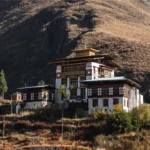
Ta Dzong translates to watch tower. The national museum was originally built as a watch tower above the Paro Dzong. Unlike other Dzongs in the country, Ta Dzong has a cylindrical structure. The sturdy watch tower has a two and a half meter thick wall with traditional windows at every level around the structure. There are historical accounts of the watch tower being used as a prison during the times of war.
After remaining uninhabited for a long time, His Majesty the Third King commanded the restoration of the tower and was inaugurated as a textile museum in 1968. Today the museum has many ancient artifacts and natural history on display. Some of the highlights include an egg laid by a mule, a horse horn, stone axe which dates back to the Stone Age.
(Traditionally, Dzongs were always built on hilltops or a strategic mountain spurs so that the occupants would have geographical advantage against their enemies in the event of attacks, which were quite frequent back then. And in the event of the Dzong being built on the side of the valley wall, a watchtower would invariably be built to serve as a lookout spot. Likewise, the Ta Dzong was built on a vintage spot directly above the Paro Dzong. It was built under the patronage of the Second Druk Desi Ngoenpa Tenzin Drukdra. The design of the structure is said to resemble the union of the sun and the moon, the blend of which is believed to symbolize victory and fame. It provided accommodation for the soldiers while at the same time serving as a prison for the prisoners of war. It is said that an underground tunnel connects the watchtower to the water source below. Sometime in 1872, when the country was still embroiled in internal feuds, Ugyen Wangchuck, the Crown Prince back then (and later the First Hereditary Monarch of Bhutan), was held hostage at the Ta Dzong. He had been sent by his father, the Trongsa Penlop Jigme Namgyal, to suppress a revolt and capture the Paro Dzong. A plot to assassinate the young Prince had been hatched but the timely discovery of the plot by Jigme Namgyel eventually resulted in the Prince’s life being saved.
In 1968, the Ta-Dzong, after being renovated, was established as a National Museum under the command of His Majesty the Third King of Bhutan Jigme Dorji Wangchuck. Today the National Museum has in its possession over three thousand works of art, covering more than 1,500 years’ worth of Bhutan’s cultural heritage. Although built with only stones and wood, without the use of nails or a blueprint as in the case of all other similar religious Bhutanese monuments, the structure proved to be much stronger than the rest. As an irrefutable testament to that fact, historical records reveal that it remained unscathed despite the massive 1714 earthquake which is said to have lasted for almost fifteen days. The Museum houses some of the finest specimens of Bhutanese art. The rich holding of various creative traditions and disciplines represent a truly remarkable blend of the past with the present and is a major attraction for local and foreign visitors alike.
Unfortunately the Ta Dzong suffered damages during the last earthquake in 2011 and is currently undergoing renovation due to which the exhibits are currently on display in an adjacent building. But it is due to reopen as the nation’s premier museum as soon as the renovation works are completed. )